
18 KiB
The All Seeing Pi (Part 2 - Software)
With the hardware set up, we can begin to program the software that will make everything work.
Test the buttons
- To begin, open the file explorer, then right click on a blank space inside the file explorer window.

- Select
Create newand then clickFolder

-
Type in the name of the folder where you will store the code and the photographs. We chose to call ours
allseeingpi. Make a note of the path to this folder which is displayed in the bar at the top, which should be/home/pi/allseeingpi -
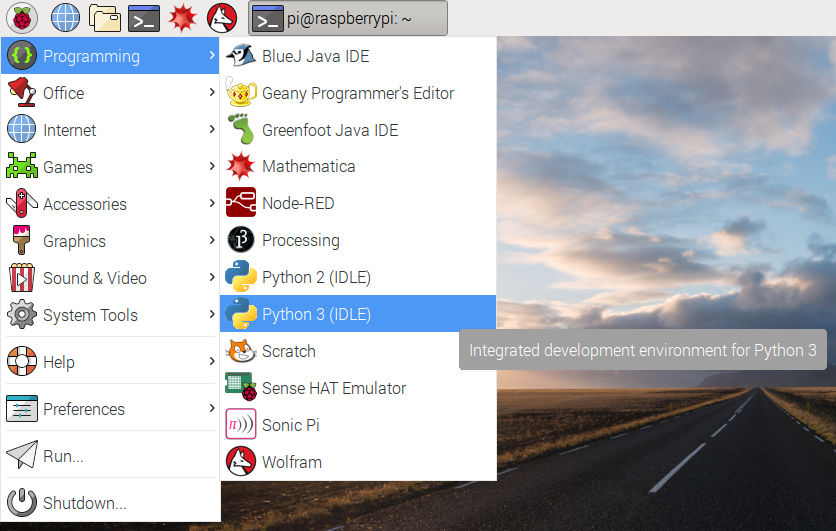
From the "Programming" menu, open up "Python 3"
-
Create a new Python file by clicking on
File>New File. -
Click on
File>Saveand save your file into theallseeingpifolder you just created, with the filenameallseeingpi.py. -
We will need the
gpiozerolibrary. At the start of your Python file add an import statement:
from gpiozero import Button
- Next we will set up the buttons. On the previous worksheet we wired our buttons to pins 23 and 25. Let's go ahead and set both buttons up.
next_overlay_btn = Button(23)
take_pic_btn = Button(25)
- Now we will use gpiozero to tell the buttons what to do when pressed. In the code below,
next_overlayandtake_pictureare functions which will be called when the corresponding button is pressed:
  next_overlay_btn.when_pressed = next_overlay
  take_pic_btn.when_pressed = take_picture
- We will write these two functions so that the buttons know what to do when they are pressed. Functions are usually written at the start of a program immediately after the
importstatements. Add the functions, but with some placeholder code to just print a message when they are pressed, so we can test them.
def next_overlay():
  print("Next overlay")

def take_picture():
  print("Take a picture")
-
Press
F5, save and run your program. Try pressing each button and check that a different message pops up for each in the Python shell.
Set up the camera
- Now that we know the buttons work, let's set up the camera. First add an import statement with the others at the top:
from picamera import PiCamera
- Locate the existing line
take_pic_btn.when_pressed = take_pictureand below it add the following code to set up the camera object:
camera = PiCamera()
camera.resolution = (800, 480)
camera.hflip = True
camera.start_preview(alpha=128)
This code creates a PiCamera object with the resolution set to 800x480 which is the resolution of the Raspberry Pi touchscreen. We also tell the camera to flip the preview horizontally (hflip) because otherwise the preview image will be mirrored and this makes it hard for people to align themselves with the overlays! We then start the preview with alpha set to 128 so that it is semi-transparent in case we get an error and need to see what is happening underneath. When you are confident your code works you can remove the alpha=128 to make the preview fully opaque.
Take a picture when the button is pressed
- Since we will probably take lots of pictures with the All Seeing Pi, we will put the date and time the picture was taken within the filename to avoid a picture being overwritten each time a new one is taken. To do this, we will need the
gmtimeandstrftimefunctions from the time library, so add this line with the otherimportstatements:
from time import gmtime, strftime
- Underneath your camera set up code, add the following line:
output = strftime("/home/pi/allseeingpi/image-%d-%m %H:%M.png", gmtime())
This will create a variable called output which contains the location and filename of where the captured photo will be saved. The %d, %m (etc) characters are how we specify the time format - %d means the day and %m means the month, for example. If you would like the date format in your filename to be different, there is a full strftime reference available. The current date and time is provided by calling the function gmtime().
- Now we will add some proper code to the
take_picture()function, so that it actually takes a picture instead of just printing a message. Locate the linedef take_picture(). Delete the lineprint("Take a picture")and in its place, add the following lines, making sure they are indented:
def take_picture():
  camera.capture(output)
  camera.stop_preview()
This code captures a picture, saving it to the location we just defined in the variable output. It then stops the camera preview.
- Navigate to the folder
/home/pi/allseeingpiand check that the picture you just took has saved correctly.
Working with overlays
-
The All Seeing Pi is no ordinary photo booth! The second button we set up,
next_overlay_btn, is used to change between 'overlays' - fun pictures such as hats, beards and glasses which appear on the screen as if you are wearing them. Here is an example of a picture taken with an overlay: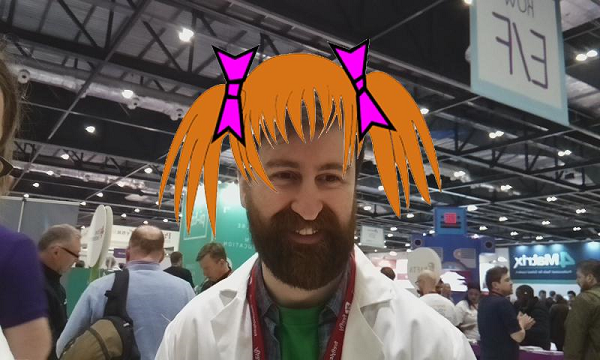
You can make your own overlays or we have provided some ready made ones that you can download in the overlays folder of the GitHub repo for this project. If you are creating your own overlays, make sure that they are saved at 800x480 resolution as PNG files, with the background set to transparent.
-
Create a subfolder within your
allseeingpifolder calledoverlaysand place your overlay images inside it. -
We will need some functions to be able to work with our overlays. If you would like to use our pre-written overlay functions, download a copy of the file and save it as
overlay_functions.pymaking sure to save it in yourallseeingpidirectory where theallseeingpi.pyscript is also saved. If you would like to see a full explanation of what these functions do, or you would prefer to write them yourself, head to the overlay functions explanation page to find out how to do this, then resume the tutorial at the following step. -
In the
overlay_functions.pyfile, find the comment# EDIT THESE VALUES ------------------------. You will need to change this code to specify two things
- Set the
overlays_dirto the directory where your overlays are stored. If you are following this tutorial exactly you will not need to change this directory location. - Set the
overlaysto be a list of the filenames of the overlays (without extension), surrounded by quotes and separated by commas. For example if you had overlay images calledrock.png,paper.pngandscissors.pngyour line of code would look like this:
overlays = ['rock', 'paper', 'scissors']
- Now go back to your
allseeingpi.pyprogram. Next to the otherimportstatements in your program, add another one to import this file:
from overlay_functions import *
This will allow us to use all of the overlay functions defined in the overlay_functions.py file, from within our allseeingpi.py file.
Change overlays with a button
- The other button you wired up to your All Seeing Pi (called
next_overlay_btn) will be the one we use to switch between the various overlays. Locate the functiondef next_overlay():and delete the indented lineprint ("Next overlay"). In its place, add the following code, making sure the lines are indented to show that they are part of the function:
global overlay
overlay = next(all_overlays)
preview_overlay(camera, overlay)
Firstly we have to declare the variable overlay as global. This means that when we change the current overlay, that value is saved 'in the global scope' which means that we can access it and use it from anywhere, and the change isn't lost when we exit this function.
The second line gets the next overlay from the list of all_overlays (defined within the overlay_functions.py file) and sets this as the current overlay. Then, the function preview_overlay() is called to display the new overlay.
- Save your program and run it by pressing
F5. Check that when you press the button to change between overlays, the overlays change. (Ensure you have at least one overlay image in your overlays folder to be able to change between them!)
Here is the program so far if you want to check your progress.
- You will notice that when you take a picture, two things happen. Firstly, the overlay does not disappear and probably makes it quite difficult to see what you are doing - close the Python Shell window to get rid of the overlay. Secondly, people can see a camera preview and can choose a silly hat from the overlays, but when they take the photograph the overlay disappears. We need to add code to remove the overlay from the screen once the picture is taken, and superimpose it onto the saved photograph.
Save overlay on your picture
- Locate the function
def take_picture():and add two lines of code at the end of the function:
def take_picture():
  camera.capture(output)
  camera.stop_preview()
  remove_overlays(camera)         # Add this line
  output_overlay(output, overlay) # Add this line
Here we are using two more functions from the overlay_functions file. The function remove_overlays does exactly what it says, and removes all of the overlays so they don't hang around after we take a photograph. The output_overlay function takes the photograph and the overlay and glues them together so the resulting final output is a photograph with the chosen overlay superimposed.
- Once again, save your file and run it using
F5to check that you can now change between overlays and when you take a photograph, your chosen overlay is saved as part of the picture.
Create a GUI
We have an almost working All Seeing Pi. However, when a picture is taken, the camera preview disappears and the user is left staring at the Python Shell and the Raspbian desktop. You probably don't want your selfie-takers to have to restart the Python program every time someone takes a picture. We will create a very simple GUI to display the picture that was taken and allow them to take another picture.
- To create the GUI we will use a library called guizero which you should have already installed in the software installation step. Add another import line with the others at the start of your program to bring in the guizero functions we need:
from guizero import App, PushButton, Text, Picture
- At the bottom of your current program, create the beginning of your GUI.
app = App("The All Seeing Pi", 800, 480)
message = Text(app, "I spotted you!")
app.display()
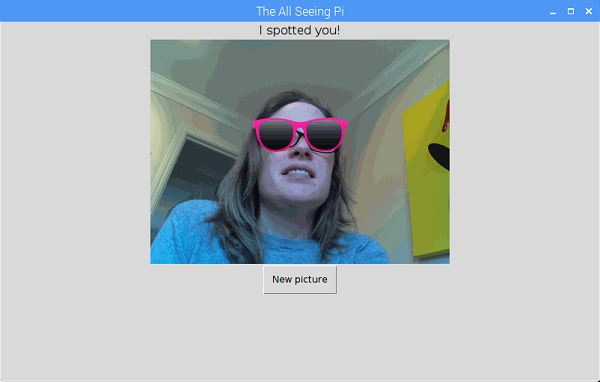
First we create an "app" which is the basic container for the GUI. The dimensions are 800 x 400 because that is the resolution of the touchscreen, and the title bar will contain the text "The All Seeing Pi". It is possible to make the GUI full screen, but we will not do this for now because it can be difficult for testing. We also add a message I spotted you! and add it to the app before displaying everything.
-
Save and run your program again. Check that when you press the button to take the photo, the camera preview exits and you see a mostly blank GUI with just a message saying
I spotted you!. -
Now between the message line and the
app.display()lines, add another line of code to create a button.
new_pic = PushButton(app, new_picture, text="New picture")
Examining the arguments passed to this PushButton object we have three parts:
app- tells the button to add itself to the appnew_picture- this is the command - when the button is pushed it will call the functionnew_picture()(which we haven't written yet!)text="New picture"- this is the text which will appear on the button
- Now write the
new_picturefunction so that the button knows what to do when it is pressed. Write this code after thetake_picture()function but before the code where we set up the buttons. Ensure that your cursor is not indented otherwise the code you write now will become part of thetake_picture()function, which we do not want.
def new_picture():
  camera.start_preview(alpha=128)
  preview_overlay(camera, overlay)
This function is very straightforward - it simply tells the camera to restart the preview, and to display the overlay (which will be the last overlay we used).
- Save and run your program using
F5once again. Check that you can press your physical button to take a picture, and that the GUI displays once the camera preview disappears. Check that you can press the on-screen button to restart the camera preview and take another picture.
Display the picture
You probably don't want your photo booth participants to have to go digging through the Raspbian filesystem to see the picture they took either, so let's display the picture they took on the GUI.
- Locate the line of code where you set the
outputfilename for the photograph usingstrftime. Immediately underneath it, add a new line of code to define the location where we will store the "latest photo" - the photo most recently taken using the booth.
latest_photo = '/home/pi/allseeingpi/latest.gif'
- Now locate the line of code where you added the
PushButtonto your GUI. Immediately before that line, insert a line of code to display an image on the GUI:
your_pic = Picture(app, latest_photo)
- The file we are referring to,
latest.gifdoes not yet exist, so if you run your program at the moment you will not see a photograph display on the GUI. We must add code inside thetake_picture()function to generate this image so it can be displayed. Locate thetake_picture()function and underneath the other code in the function, add the following lines (remembering to ensure that the new lines of code are also indented):
size = 400, 400
gif_img = Image.open(output)
gif_img.thumbnail(size, Image.ANTIALIAS)
gif_img.save(latest_photo, 'gif')

your_pic.set(latest_photo)
This code opens the output image (the image containing the photo combined with the overlay) and creates a smaller thumbnail of that image in gif format and saves it at the location set up in latest_photo. It then sets the image on the GUI (your_pic) to be that latest photo image using the set() function which is part of the guizero library.
-
Save your code and test whether when you take a photograph it is displayed on the GUI. You may find that there is a short delay between the camera preview exiting and the image displaying on the GUI while it is saving.
Tweet picture
If you just want a fun photo booth to take and save pictures, you could stop there. Alternatively, why not go one step further and make your All Seeing Pi tweet the photo that was taken.
-
You will need to set up a Twitter account and create an app for your All Seeing Pi. Follow steps 1-4 on the Getting started with the Twitter API resource in a separate file and check that you can successfully send a text tweet from Python.
-
Save a copy of the
auth.pyfile containing your Twitter API keys (which you created during the "Getting started" tutorial) inside your/home/pi/allseeingpifolder. -
Go back to your
allseeingpi.pyfile and after the other import statements, import Twython:
from twython import Twython
- Immediately after importing Twython, add the following code to import your Twitter API credentials from your
auth.pyfile:
  from auth import (
    consumer_key,
    consumer_secret,
    access_token,
    access_token_secret
)
- Create a new function after the
new_picture()function, calledsend_tweet():
def send_tweet():
- Inside the function, instantiate a Twitter object:
def send_tweet():
  twitter = Twython(
    consumer_key,
    consumer_secret,
    access_token,
    access_token_secret
  )
- Add some more code inside the
send_tweet()function to tweet theoutputpicture. You can change themessageif you want your tweet to say something different:
message = "The All Seeing Pi saw you!"
with open(output, 'rb') as photo:
    twitter.update_status_with_media(status=message, media=photo)
- Now find the code for the GUI where you create the
PushButtonfor a new picture, and add anotherPushButtonunderneath it which will call thesend_tweet()function when it is pressed:
tweet_pic = PushButton(app, send_tweet, text="Tweet picture")
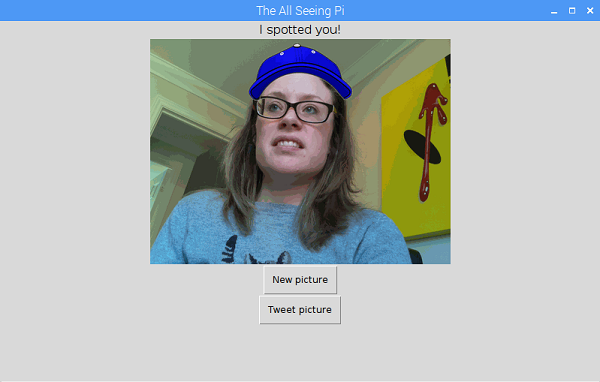
- Save and run your program. Test that when you take a picture and press the Tweet picture button on the GUI, the picture is tweeted from your twitter account.

The finished code is here for you to check against yours.
What next?
- Can you add a text box or perhaps a touch screen keyboard to your GUI to allow someone to enter their Twitter handle?
- Can you add an
@usernamemention to the tweet text, using the Twitter handle that was entered via the GUI? - Could you make a more imaginative housing for your All Seeing Pi?